Split the field
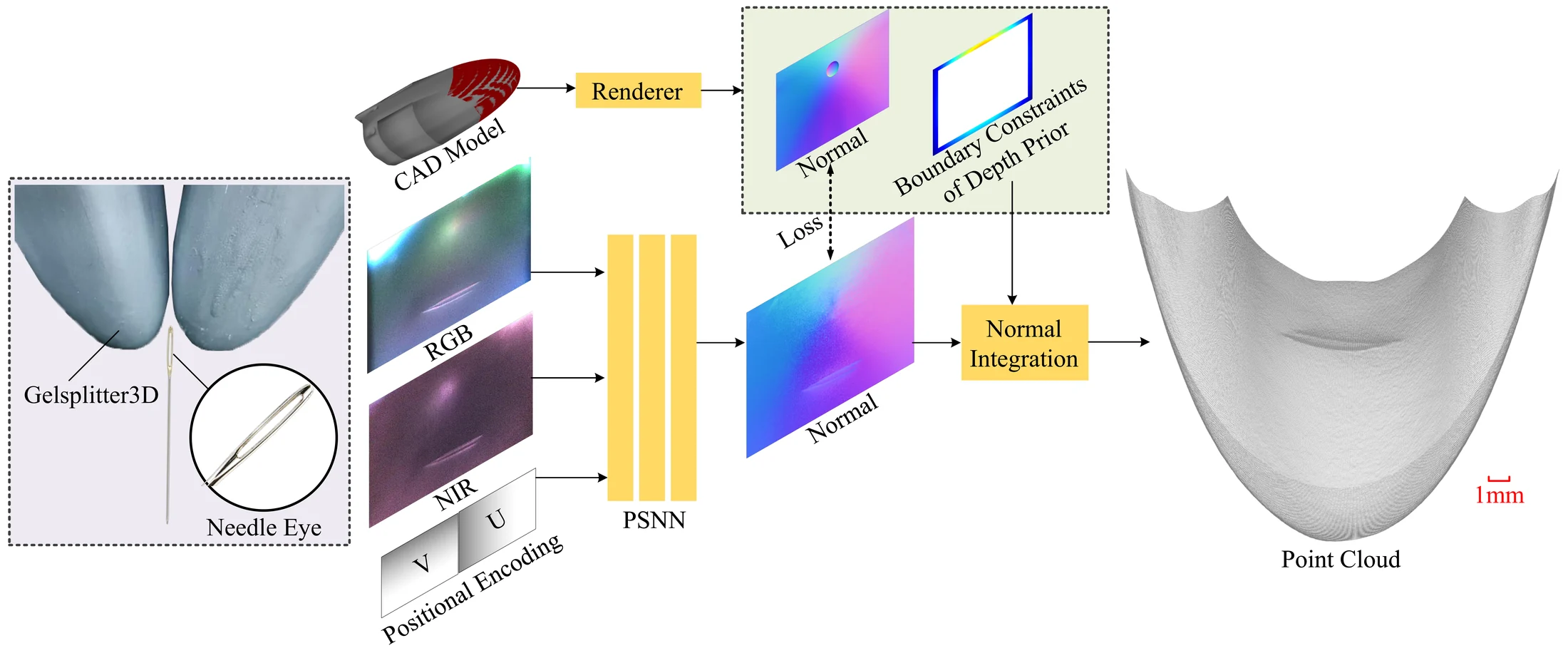
A prism redirects the same tactile image plane to RGB and NIR cameras, adding complementary observations without fragmenting the contact view.
A curved robotic fingertip that splits one optical field into complementary RGB and near-infrared observations, then reconstructs contact geometry with neural photometric stereo.
State Key Laboratory of Digital Manufacturing Equipment and Technology
Huazhong University of Science and Technology
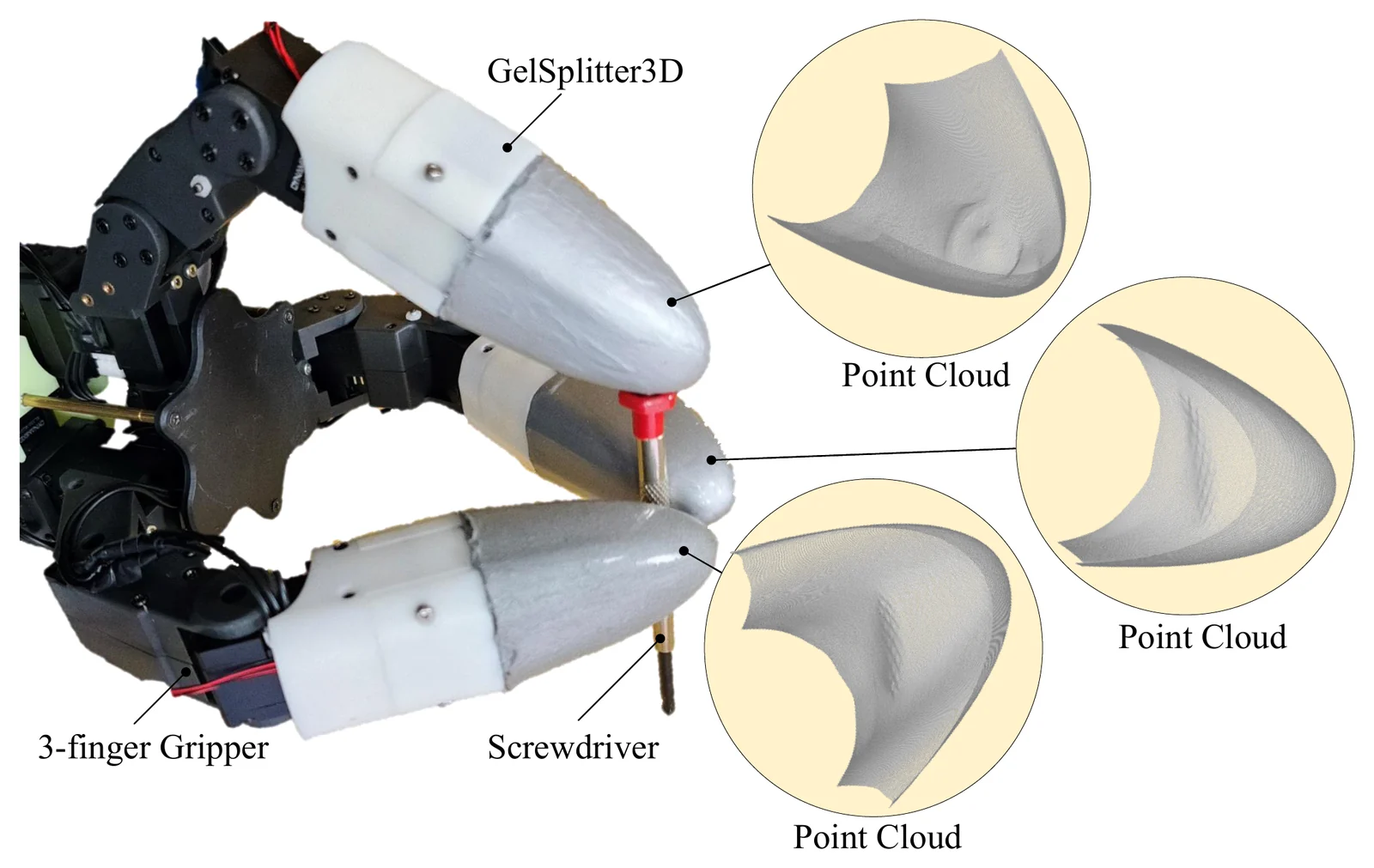
Beyond planar touch
Anthropomorphic fingertips offer continuous contact over complex object geometries, but their rapidly changing surface gradients make uniform illumination and faithful reconstruction difficult.
A prism redirects the same tactile image plane to RGB and NIR cameras, adding complementary observations without fragmenting the contact view.
A photometric stereo neural network maps RGB-NIR intensities and positional encoding to a dense surface-normal field.
CAD-derived boundary depth priors suppress cumulative integration drift on the non-planar sensing surface.
One contact. Two spectra.
The optical path preserves a common field of view while directing visible and near-infrared signals toward dedicated cameras. Four embedded light sources create complementary photometric cues across the fingertip.
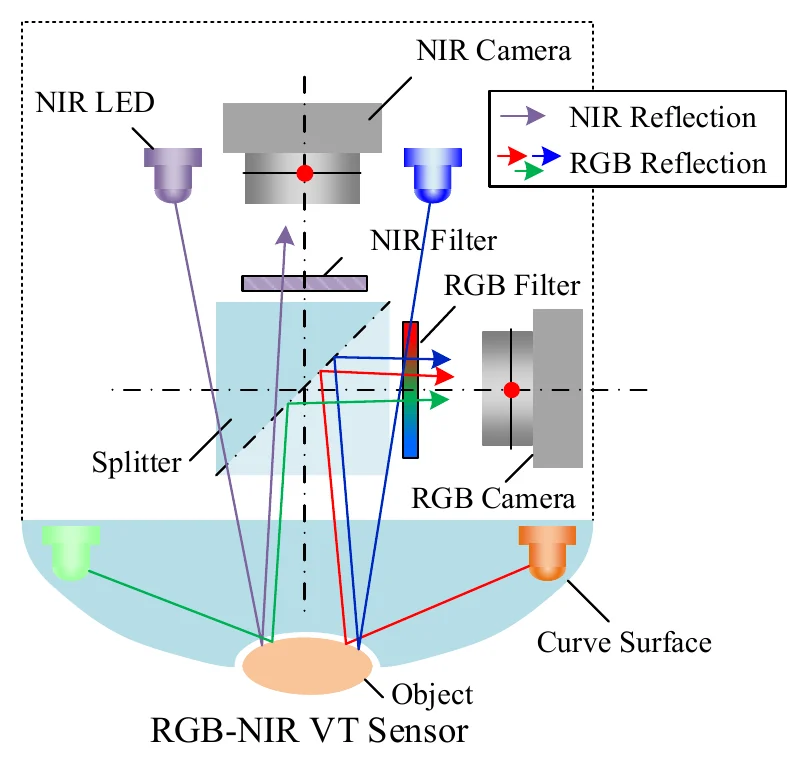
Both cameras observe the same curved contact region, keeping spectral evidence spatially aligned.
Near-infrared illumination recovers shape and texture evidence that can be ambiguous in visible channels alone.
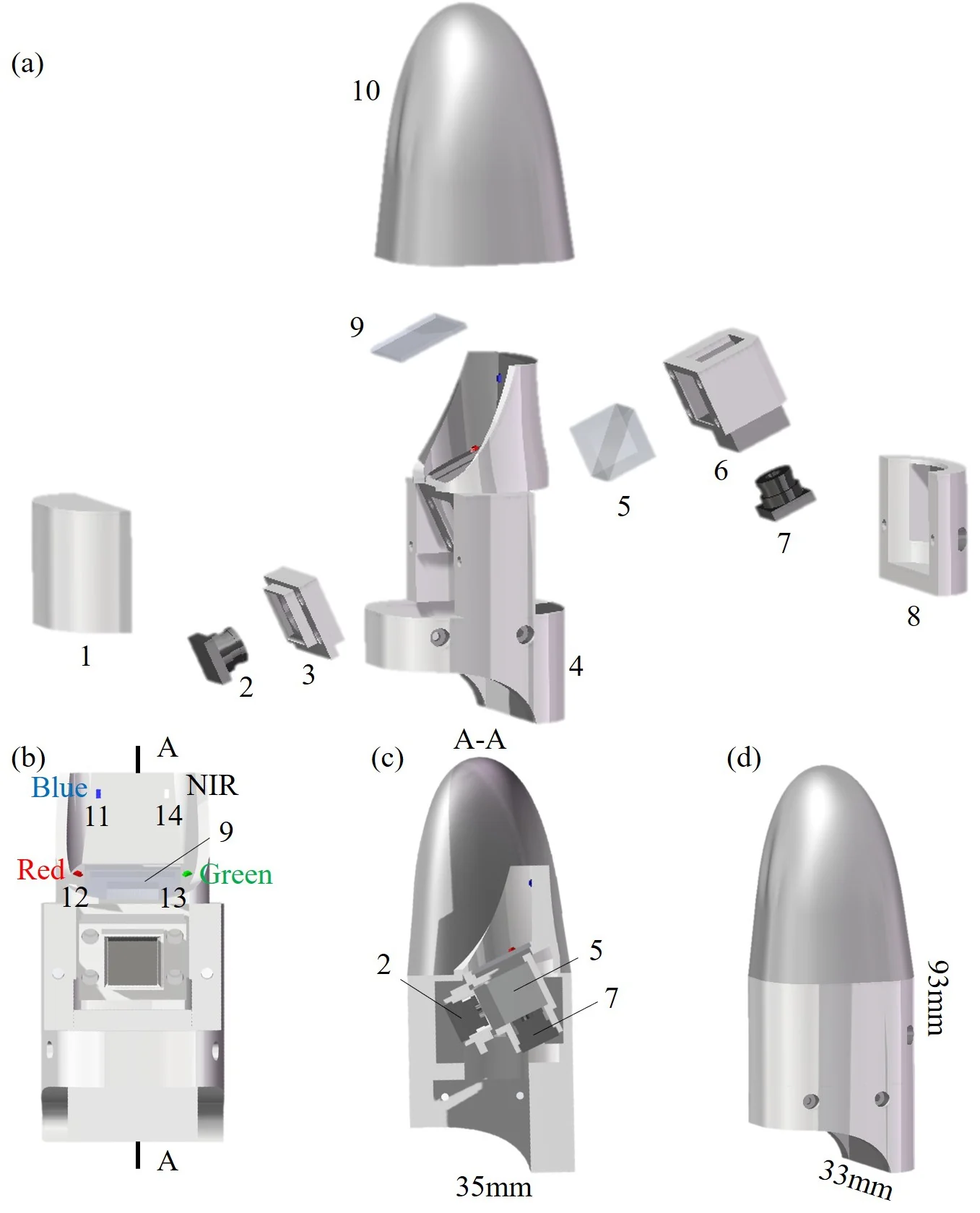
The optical assembly is integrated around a finger-like gel contact module instead of treating curvature as an afterthought.
Designed as a fingertip
Camera mounts, illumination, prism, acrylic support, and the gel contact module are co-designed around the sensing geometry. The result can be mounted directly on a dexterous three-finger gripper.
From mold to sensing skin
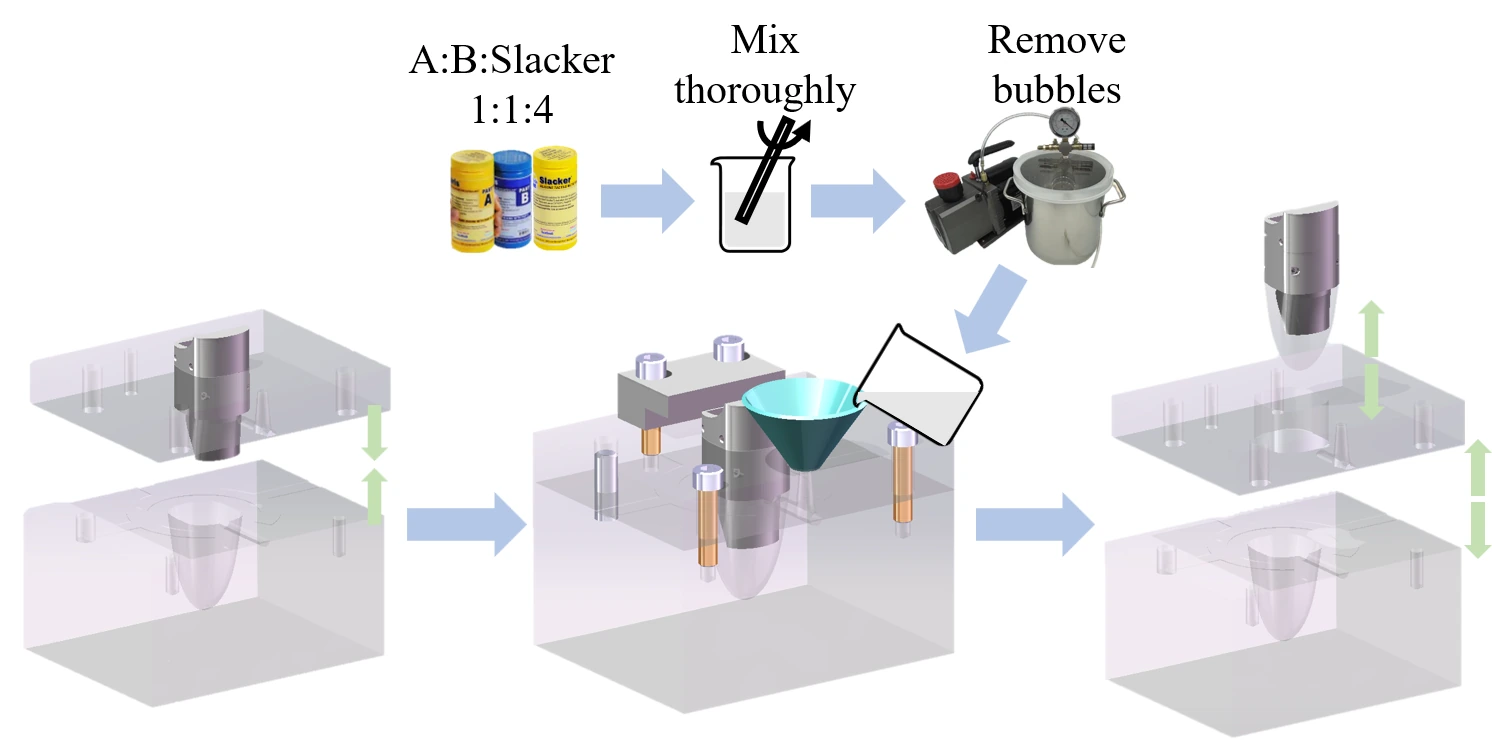
The finger-shaped elastomer is cast in a multi-part mold, cured, coated, and assembled with the internal acrylic structure to form a continuous tactile surface.
Pixels to contact geometry
Calibration begins with CAD-derived supervision, then moves from aligned RGB-NIR observations to surface normals and a boundary-anchored depth map.
A spherical probe samples contact positions while the known sensor geometry supplies dense normal supervision.
Pixel intensities and positional encoding are mapped to normal vectors through a compact multilayer perceptron.
Boundary depths from the CAD model constrain normal integration and prevent global drift across the curved surface.
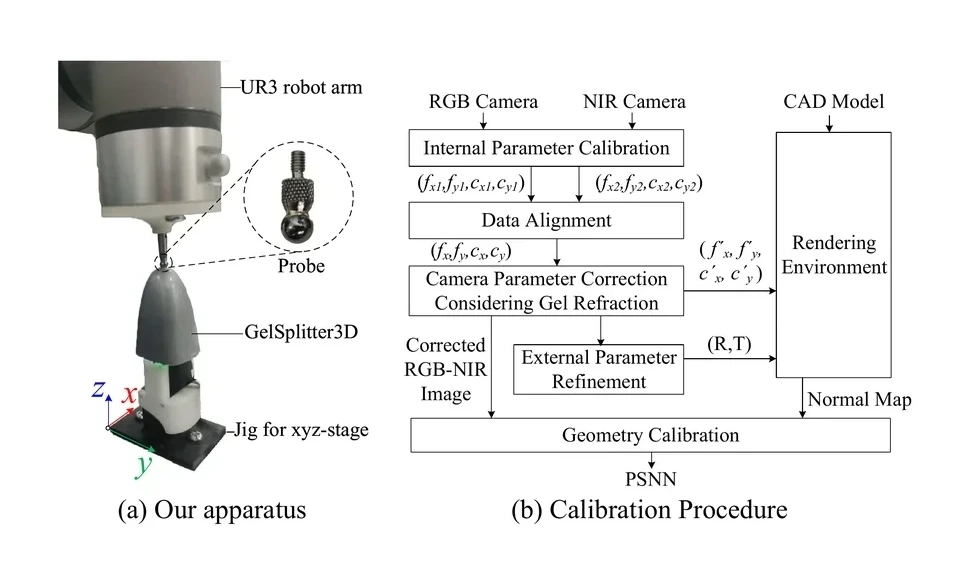
Robot-controlled sampling links physical contact locations to CAD-derived geometric supervision.
Fine structure, recovered
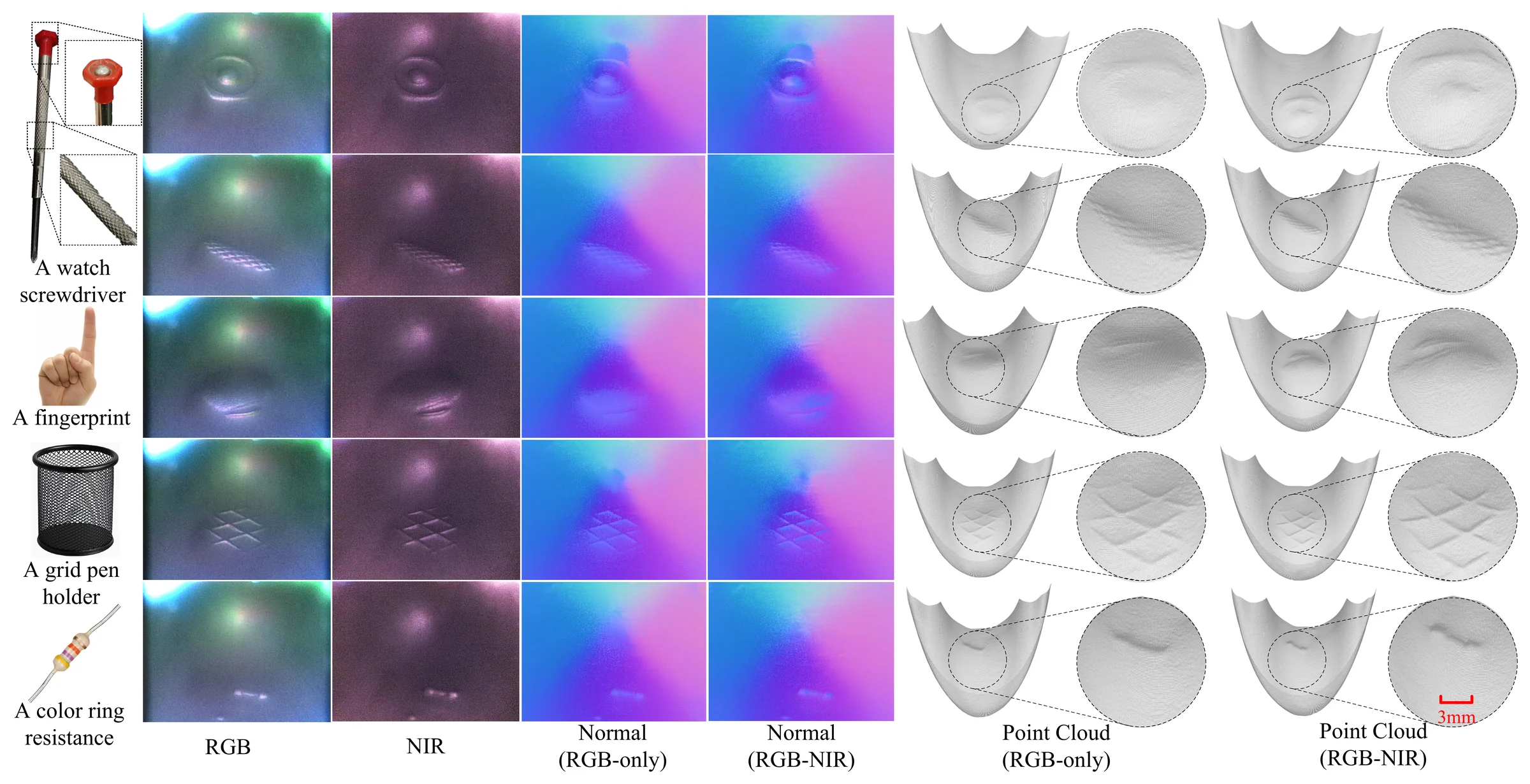
Across a watch screwdriver, fingerprint, grid texture, and color-ring resistor, RGB-NIR reconstruction preserves sharper contours and microscopic relief.
RGB-NIR total gradient MAE
lower gradient MAE than RGB-only PSNN
depth reconstruction MAE
Gx / Gy MAE
Normal integration
Classical planar boundary assumptions fail on the curved fingertip. Adding flexible boundary handling helps; anchoring the integration with CAD-derived edge depth reduces the error further.
The sensing loop, in motion
GelSplitter3D hardware and synchronized tactile reconstruction. 00:52
Use this work
Published in the 2025 IEEE/RSJ International Conference on Intelligent Robots and Systems.
@inproceedings{lin2025gelsplitter3d,
  title     = {3D Vision-tactile Reconstruction from
               Infrared and Visible Images for Robotic
               Fine-grained Tactile Perception},
  author    = {Lin, Yuankai and Lu, Xiaofan and
               Chen, Jiahui and Yang, Hua},
  booktitle = {2025 IEEE/RSJ International Conference
               on Intelligent Robots and Systems (IROS)},
  pages     = {16023--16029},
  year      = {2025},
  doi       = {10.1109/IROS60139.2025.11246893}
}